
Building Inspection Cashmere
BUILDING REPORT CASHMERE
Residential & Commercial Building Reports
Alert Building Inspections provides professional building inspections across Cashmere and Christchurch for home buyers, sellers, and property investors. Our trade-qualified building inspectors thoroughly assess the property, explain what they find, and provide practical advice through a comprehensive written or verbal builders report. With fast bookings and reports available within 24-48 hours, getting the information you need is simple.
CUSTOMER REVIEWS
Cashmere’s Unique Building Challenges
Cashmere's housing grew up around the tram line and the sanatorium in the early 1900s, then filled in steadily for the next ninety years — grand early villas and bungalows on the lower slopes, post-war brick and tile family homes, and townhouse and infill development on subdivided sections. Unlike the flat suburbs, it was never built in a single wave. Set that against a hillside where the ground itself changes from section to section, and every Cashmere property has its own inspection priorities.
Volcanic rock capped with loess — a windblown glacial silt that is moisture-sensitive and prone to cracking, erosion and slumping — steep driveways cut into the slope, retaining walls doing structural work every day, and a dry but exposed climate all affect how a Cashmere building performs over time. Knowing which apply to your property is the difference between a building report that lists observations and one that tells you what you're taking on.
TESTING
Report
BUILDERS REPORT CASHMERE
Fast Turnaround 24-48 hours
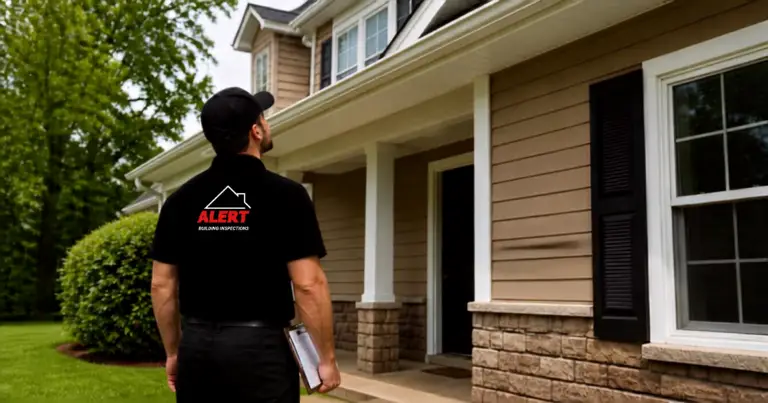
A builders report from Alert tells you what a viewing can't. Our trade-qualified inspectors are practising builders, and they assess structural integrity, weathertightness and maintenance requirements across every accessible area of the property, in accordance with NZS 4306:2005.
Every report is written in plain English, with findings categorised by severity, photographs of each issue, and specific recommendations — not a checklist of ticks and crosses. All major banks and lending institutions accept our reports.
We inspect across Cashmere and the surrounding south-west Christchurch suburbs — Beckenham, Somerfield, St Martins, Westmorland, Huntsbury, Hoon Hay and Spreydon — as well as the wider Christchurch area from Rangiora and Kaiapoi in the north through to Rolleston and Prebbleton in the south.
Call 0800 4 ALERT or book online for a firm quote based on your property address.
+
+

HOUSE INSPECTION CASHMERE
"House inspection" and "building inspection" mean the same thing. If you are buying a home in Cashmere, this is the report you need — a trade-qualified inspector on site, assessing the property in person. On the day, the inspector works through the property in a set order: the exterior and roof first, then the roof space, then the interior, and finally the subfloor, where accessible. That order is deliberate.
In Cashmere, the most expensive problems are usually where the house meets the ground and where the weather meets the cladding. A retaining wall that has moved, loess that has cracked and let water in, drainage that no longer carries water away, and the complex junctions on terraced and split-level homes all sit outside the living areas. None of that is visible from inside a room.
That is also why a Cashmere inspection is different from one on the flat. Because the slope changes from section to section, hillside houses were designed individually — cut-and-fill platforms, stepped footings, integrated retaining — so there is no standard plan to compare against. The inspection is about whether what is actually there is performing.

BUILDING INSPECTOR CASHMERE
24-48 Hour Report Delivery Guaranteed
Looking for a Building Inspector in Cashmere? Our trade-qualified inspectors provide thorough building reports with meticulous attention to detail.
Our Cashmere building inspection service is perfect for time-sensitive property purchases. Each inspector carries professional indemnity insurance and brings deep knowledge of Cashmere's local market and common building challenges — retaining walls showing movement or drainage failure, loess-related ground cracking and slumping, stormwater that no longer discharges clear of the house, and weathertightness failures at cladding junctions on plaster-clad homes from the late 1980s to 2004.
Because hillside ground is so variable and foundations were individually engineered, we assess the visible condition of retaining and the way surface water is managed around the building, alongside the usual structural and weathertightness checks. All inspections comply with NZS 4306:2005 standards for comprehensive, reliable assessments.

Pre Sale Building Inspection Cashmere
Purchasing a home is a major investment. Our in depth inspection helps you understand the property's condition before making a decision. We provide a thorough assessment, examining everything for potential issues such as moisture or pests, to give you confidence in your purchase.

Pre-Purchase Building Inspection Cashmere
Our inspection are designed to protect your investment. Conducted by experienced and qualified inspectors, we identify hidden defects, safety concerns, and maintenance issues. You’ll receive a detailed, easy-to-read report that empowers you to make informed choices.

Your Inspection Completed Within 24-48hrs
Need results fast? Our fast turnaround provides a thorough property review with detailed findings delivered on the same day. Perfect for time-sensitive situations, this service ensures you can move forward with confidence without delays or unnecessary waiting periods.
Our Working Process
Book
Confirm
Inspect
Report
Christchurch - Areas of Service
Addington, Akaroa, Amberley, Aranui, Avonhead, Avonside, Belfast, Bishopdale, Burnham, Burnside, Burwood, Casebrook, Cashmere, Cheviot, Christchurch CBD, Culverden, Cust, Darfield, Diamond Harbour, Dunsandel, Edgeware, Ellesmere, Fendalton, Fernside, Ferrymead, Halswell, Hanmer Springs, Harewood, Hoon Hay, Hornby, Ilam, Kaiapoi, Kirwee, Leeston, Leithfield, Lincoln, Linwood, Little River, Lyttleton, Mairehau, Malvern, Merivale, New Brighton, Northwood, Oxford, Papanui, Pegasus, Phillipstown, Prebbleton, Rangiora, Redwood, Riccarton, Rolleston, Southbridge, Spreydon, Springs, St Albans, Sumner, Swannanoa, Sydenham, Tai Tapu, Waiau, Waikuku, Waipara, Waltham, West Eyreton, West Melton, Wigram, Woolston.
Cashmere Building Types by Era
Cashmere's housing spans more than 130 years, and unlike the flat suburbs, it was never built in a single wave. The result is one of the most varied housing stocks in the city, on ground that changes from section to section. Understanding which era your property belongs to — and what the slope beneath it is doing — tells you a great deal about what an inspector will be looking at.
1890s to 1910s — Hillside Villas and the Tram Years
The first houses went up on the lower slopes in the 1890s, and the suburb grew as the tram line pushed up Dyers Pass Road. Cashmere became fashionable, with a slightly bohemian reputation, and the name itself came from the Kashmir estate of early settler John Cracroft Wilson.
Homes from this first wave are the ones people picture when they think of Cashmere: generous villas and bungalows on the lower slopes, many with native timber framing, bay windows and deep verandahs, positioned to take the sun and the view. More than a century on, inspection questions focus on maintenance and alteration history rather than the original build — borer in subfloor framing, original piles, and how the weatherboards have been treated over the decades.
1910s to 1930s — The Sanatorium Era and Bungalow Christchurch
This period gave Cashmere one of its most distinctive landmarks. The Cracroft-Wilson family donated land at the edge of the Cashmere estate, and the Cashmere Sanatorium opened there in 1910, with rows of small open-air timber shelters terraced across the hillside for tuberculosis patients — around 10,000 people were treated between 1910 and 1960. Coronation Hospital, for advanced cases, opened further down the hill on 3 June 1914. The last patient left in 1960; the hospital closed in December 1991, and the remaining buildings came down in 1993 for the Broad Oaks subdivision. One shelter survives, restored at Coronation Reserve.
The residential building of this period was the bungalow: lower, wider and more enclosed than the villa, typically with roughcast or brick cladding and a hipped roof. Many survive in good original order and update well. Recurring issues are the same as in any 90-year-old house — roof and flashings, old joinery, original wiring, and past additions that may or may not have been consented. An older home also raises the question of asbestos-containing materials, which were used in New Zealand building products until the 1980s.
1950s to 1970s — Post-War Infill on the Hills
After the war, Cashmere filled in. Sections left as orchard or paddock were subdivided, and the suburb gained the brick-and-tile and weatherboard family homes that now make up a large share of it. Aluminium joinery arrived late in this period and became standard.
Hillside sites from this era are where the "every house is a prototype" rule really shows. Because the slope varies from section to section, these homes were designed individually — split levels stepping down the hill, cut-and-fill platforms, and integrated retaining walls holding the ground behind the house. That approach is a strength when done well and a long-term liability when it isn't, because there is no standard detail to compare it against.
1970s to 1990s — Toe Slopes and the Leaky Era
Two things happened in this stretch. The gentler ground at the base of the hills—the low-angle toe slopes where the Port Hills grade into the flat, with higher water tables and loess colluvium—was subdivided for housing, mostly after 1970. And from the late 1980s monolithic cladding systems became common across New Zealand, which put homes built between roughly 1988 and 2004 into the highest-risk bracket for weathertightness failure.
Both matter at inspection. Toe-slope ground is where the loess has slumped and where earthquake damage concentrated. And a plaster-clad home from the 1990s on a hillside — with its complex junctions, cut-in levels and multiple cladding interfaces — is exactly the kind of building where moisture gets in and stays in. That is why moisture testing matters so much on a house from this period.
2000s to Today — Rebuilds, Reclads and New Builds
The earthquakes reshaped the hills. Some houses were rebuilt, many were repaired, and many retaining walls and driveways were replaced. Modern builds use current code detailing — cavity systems behind cladding, treated framing, stricter weathertightness provisions — and are generally well constructed.
The inspection questions change accordingly. On a rebuilt or repaired house, both quality and paperwork matter: what was done, by whom, under what consent, and whether the work has performed. On a new build, the issues are the ones that turn up across the city — missed flashings, drainage never properly connected, sealant joints never finished, and finishing defects that suggest a rushed programme.
What the Hills Mean for a Cashmere Home
A well-maintained Cashmere home is a genuinely good property. The early houses were well built, the setting is unmatched, and the suburb has held its value through everything the last fifteen years threw at it. But a hillside home has a different maintenance profile to one on the flat, and a list of components that age, move, or both. Here is what we look at most closely.
Retaining walls. This is the item that catches Cashmere buyers out. A hillside section often has at least one retaining wall doing structural work, and unlike the house, it is not always consented, documented, or maintained. Earthquakes stressed a large number of walls across the Port Hills, and a wall that has moved, bulged, or lost its drainage is an expensive repair—often a five-figure sum, and more where access is difficult. We assess what is visible: the wall's condition, its alignment, signs of movement, and whether drainage appears to be working. Anything structural needs a geotechnical engineer, and we will say so.
Loess and slope movement. Much of the Port Hills is capped with loess — windblown glacial silt, in places tens of metres deep — over volcanic rock. Loess is moisture-sensitive. It cracks, fissures, erodes and slumps, and a large share of the earthquake damage on the hills was ground movement in loess rather than anything wrong with the houses themselves. Visible tension cracks in the ground, a driveway that has dropped, or a fence line that has shifted are all worth taking seriously — that is where foundation performance and the ground beneath it need proper investigation.
Hillside drainage. Water on a hillside goes downhill, and it does not stop at your boundary. Cut driveways act as channels, upslope properties shed water onto downslope ones, and drainage designed for the section stops working the moment it isn't maintained. Blocked or inadequate stormwater, a gully trap discharging too close to the foundation, and surface water running toward the house rather than away from it are common findings—and they show up as damp first, not as obvious leaks. This is one of the most common reasons we recommend moisture testing.
Technical categories and the Port Hills. This is the most widely misunderstood point, so it is worth stating plainly. The TC1, TC2 and TC3 categories people talk about across Christchurch describe liquefaction and settlement risk, and they were applied to flat residential land. Properties on the Port Hills generally weren't given a technical category, because hillside sites have always required site-specific foundation design and are not generally subject to liquefaction. On the hills, the relevant hazards are different — rockfall, cliff collapse, landslip, and mass movement — and they are managed through separate Council hazard overlays. So a technical category tells you very little about a Cashmere property; the Council's hazard maps and the LIM hold that information, and they are worth checking before you commit.
Cladding and weathertightness. Cashmere is dry by Canterbury standards, but it is exposed, and it takes the nor'wester head-on. Hillside homes also tend to have more complex envelopes than flat-land houses — multiple levels, cut-in walls, decks over retaining structures, and junctions where cladding systems meet masonry. More junctions means more places for water to get in, so weathertightness deserves particular attention, especially on plaster-clad homes from the late 1980s through to 2004.
Foundations and site-formed construction. Hillside foundations vary enormously. Some homes sit on conventional perimeter footings bearing on rock; others sit on cut-and-fill platforms, stepped footings, or piles that may brace and anchor the house against the slope. Because each was individually engineered, an inspector's job is to read what is actually there rather than assume a standard detail. Any evidence of differential movement—cracks that step, doors and windows that have gone out of square—warrants a proper structural inspection.
Roofing. Hillside homes tend to be more exposed than flat-land ones, and many have roofs that are past the age where maintenance is optional. Original concrete tile roofs are now 40 to 65 years old, and the bedding and pointing on the ridge and hip caps fail first — not the tiles. Corroding fixings, perished flashings and failed valleys follow. A roof inspection is often the cheapest way to find an expensive problem before you buy.
Plumbing, wiring and insulation. A large share of Cashmere's housing predates modern standards. Older switchboards, limited or no RCD protection, original pipework reaching the age where failures become recurring, and insulation well below current requirements are all common across the suburb's pre-1970s stock — and insulation matters more on the hills, where a shaded or south-facing home is genuinely cold.
Frequently Asked Questions
How much does a building inspection cost in Cashmere?
Our comprehensive building inspection and the report start from $299, and can go higher depending on the size and nature of the property. The key factor in determining price of your building inspection is your address, so you'll know upfront the cost you're looking at.
What do you check on a hillside home in Cashmere?
We check the accessible structure from the foundation to the roof — the cladding and its junctions, the roof and flashings, the roof space, the interior, and the subfloor or any accessible foundation and retaining elements. On a hillside we pay particular attention to the way the house meets the ground: cut-in walls and the retaining that holds them, evidence of movement, and how stormwater and surface water are managed around the building. Cracks that step, doors and windows that have gone out of square, and any dropped or lifted hard landscaping are all reported.
Do I need a geotechnical report in Cashmere?
Not always, but it is often worth having one. A building inspection is a visual assessment and it can identify signs of ground movement, cracking or retaining wall distress — but it cannot tell you what is happening below the surface, or whether a slope is stable. Where we see anything of that kind, we will recommend a geotechnical engineer. If you are buying on the hills, it is also worth checking the Council's hazard overlays and the LIM report before you commit.
How long does a building inspection take in Cashmere?
Most building inspections take 1-2 hours, depending on the property size and condition. A large or steeply terraced hillside home can take longer.
Do you check retaining walls in Cashmere?
Yes. We visually assess any retaining wall we can access — its condition, its alignment, signs of bulging, leaning or movement, and whether drainage appears to be working. What we cannot do is certify a wall's structural adequacy, and a wall retaining a slope above or below a dwelling needs a geotechnical engineer. We will tell you when that is the case.
Is Cashmere on good ground?
It is different ground rather than better or worse. Cashmere sits on volcanic rock capped with loess, a windblown glacial silt that is moisture-sensitive, so the soil conditions vary from section to section and are unlike the flat city. Two things follow from that. Hillside sites have always required a site-specific foundation design, and properties on the Port Hills were generally not given a TC1, TC2 or TC3 technical category at all — those categories describe liquefaction and settlement risk on flat land. The hazards that matter on the hills are rockfall, cliff collapse and landslip, which the Council manages through separate hazard overlays. A building inspection reports what is visible; the hazard overlays and LIM cover the wider site risk.
Should I worry about asbestos in an older Cashmere home?
Asbestos-containing materials were widely used in New Zealand building products until the 1980s, and Cashmere has a lot of pre-1980s housing. The more common locations are soffits, eaves linings, vinyl floor tiles, textured ceilings, and older ducting and pipe lagging. If it is intact and undisturbed it is generally considered low risk, but it will need to be managed during any renovation. Our inspection will report any materials that may contain asbestos; confirmation requires specialist testing, which we can recommend. There is more detail in our article on asbestos in New Zealand homes.
What is loess and why does it matter in Cashmere?
Loess is windblown glacial silt, and much of the Port Hills is capped with it — in places tens of metres of it, over volcanic rock. It is moisture-sensitive: it cracks, fissures, erodes and slumps when water gets into it, and a large share of the earthquake damage on the hills was ground movement in loess rather than anything wrong with the houses. For a buyer, that means visible ground cracks, a dropped driveway or a shifted fence line are worth taking seriously rather than patching over.
Do you offer pre-purchase building inspections in Cashmere?
Yes. Our pre-purchase building inspections in Cashmere help buyers make informed decisions and avoid costly surprises after purchasing a property.
Do I need a building inspection for a new build in Cashmere?
Yes. New builds can have incomplete work, missed flashings, poorly connected drainage, and finishing defects. On a hillside we also check how the new building has been integrated with the slope — the retaining, the cut, and the drainage. An independent inspection gives you verification that the property was built to the standard it should have been.
Can I attend the building inspection?
Absolutely! We encourage clients to attend their building inspection to gain firsthand insights and ask questions directly to our inspector in Cashmere.
Are your building inspectors qualified in Cashmere?
Yes, our building inspectors are fully qualified and experienced in Cashmere's building standards, ensuring accurate and reliable reports. Every inspector carries professional indemnity insurance, and our inspections comply with NZS 4306:2005.
What common issues are found during building inspections in Cashmere?
Typical issues while conducting a building inspection in Cashmere include: retaining walls showing movement or drainage failure; ground cracking and slope movement in loess; stormwater and surface water not being managed away from the building; weathertightness failures at cladding junctions, particularly on late-1980s to 2000s plaster-clad homes; roof bedding and pointing at the end of its life on older tile roofs; original wiring and plumbing in pre-1970s houses; insulation well below current standards; and cracking to foundations or hard landscaping from past ground movement.
Building inspections near me?
Looking for building inspection services in Cashmere? Alert Building Inspections provides detailed building reports within 24-48 hours, conducted by trade-qualified inspectors who understand Cashmere's property market and the particular demands of building on the Port Hills. We follow the New Zealand Standard for Property Inspections (NZS 4306:2005) and serve Cashmere and the surrounding suburbs, including Beckenham, Somerfield, St Martins, Westmorland, Huntsbury, Hoon Hay and Spreydon.
