
Alert Building Inspections provides professional building inspections across Palmerston North for buyers, sellers and investors. Our trade-qualified building inspectors check properties from foundation to roof, identifying defects, moisture concerns, and maintenance issues. You'll receive straightforward advice and, when required, a detailed written builders report within 24-48 hours.
Palmerston North's building stock spans more than a century, from early villas and workers' cottages in the inner suburbs to the brick-and-tile housing boom of the 1950s to 1970s, and the newer subdivisions spreading east and south across the plains. Built on the flat, alluvial terraces of the Manawatū River, and sitting in one of the windiest cities in the country, every Palmerston North property has its own inspection priorities.
Alluvial river-terrace soils, a shallow water table in the lower-lying suburbs and a windy, wind-driven-rain climate all affect how a Palmerston North building performs over time. Knowing which apply to your property is the difference between a building report that lists observations and one that tells you what you're taking on.
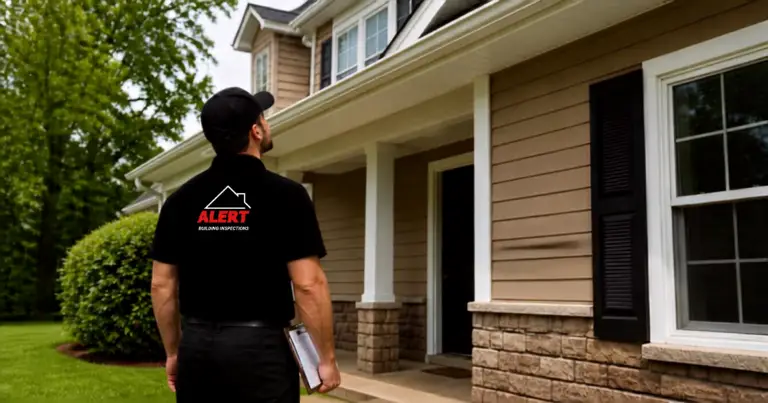
Fast Turnaround 24-48 hours
A builders report from Alert tells you what a viewing can't. Our trade-qualified inspectors are practising builders, and they assess structural integrity, weathertightness and maintenance requirements across every accessible area of the property, in accordance with NZS 4306:2005.
Every report is written in plain English, with findings categorised by severity, photographs of each issue, and specific recommendations — not a checklist of ticks and crosses. All major banks and lending institutions accept our reports.
We inspect across Palmerston North and the wider Manawatū — from the city and its suburbs through to Feilding, Levin, Foxton, Woodville and Ashhurst, and out across the surrounding plains.
Call 0800 4 ALERT or book online for a firm quote based on your property address.
+
+
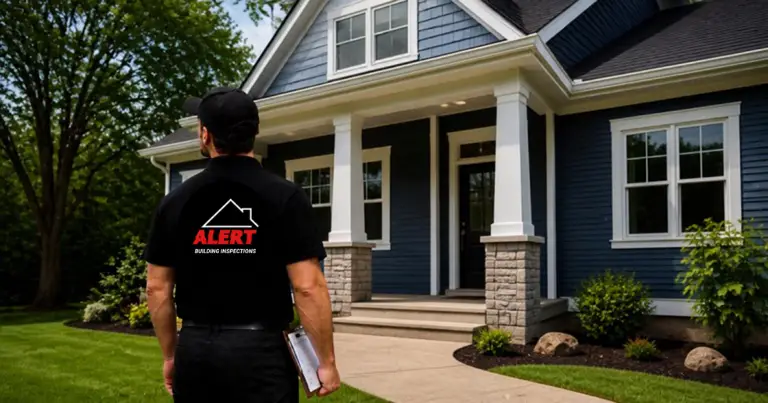
"House inspection" and "building inspection" mean the same thing. If you are buying a home in Palmerston North, this is the report you need — a trade-qualified inspector, on site, assessing the property in person.
On the day, the inspector works through the property in a set order: the exterior and roof first, then the roof space, then the interior, and finally the subfloor wherever it is accessible. That order is deliberate. In Palmerston North houses, the most expensive problems are usually found from above or below the living areas rather than inside a room — wind-driven rain getting past roof flashings and cladding junctions from the outside, and decay or damp from beneath.
One thing worth knowing before you book: a house inspection is not a valuation. They do different jobs — a valuation assesses market value, a house inspection assesses condition — and your lender may require both. Buyers often assume one covers the other.
Call 0800 4 ALERT or book online for a firm quote based on your property address.

Investing in Palmerston North property is a major financial commitment, and a pre-purchase building inspection helps protect it. Our building inspectors know this city's building stock — from the post-war brick and tile homes of the 1950s to 1970s, to the older timber villas and workers' cottages closer to the centre, to the unconsented alterations that often show up in renovated homes.
Each property is assessed from the foundation through to the roof structure, in accordance with NZS 4306:2005. That covers structural components, weathertightness, visible plumbing and electrical components, and moisture testing throughout. It gives you the facts you need to renegotiate the price, request repairs, or walk away.
Schedule your inspection and your written report arrives within 24–48 hours — in time for a conditional deadline or an auction date. Every report includes moisture testing results, photographs, findings categorised by severity, and specific recommendations.

If you need answers quickly and don't require a written report, a verbal inspection provides a professional assessment of the property, with the findings explained directly to you. It's a simple option for buyers who want an experienced opinion before deciding how to proceed.
For a complete record of the inspection, our written option includes a detailed building report, photographs and practical information about the property's condition. We provide reports within 24-48 hours, and you can use them for due diligence, lending requirements, and planning future maintenance.
Meth contamination can be expensive to deal with once you own the property. Same-day on-site methamphetamine screening can be completed alongside your inspection, helping identify potential contamination before settlement. Testing starts at $279 + GST.
Previous owners may have completed renovations or alterations without council consent. Our Safe & Sanitary Reports can help support a Letter of Acceptance application by assessing the completed work and providing relevant documentation. Prices start from $699 + GST.

Purchasing a property is one of life's biggest investments – getting a professional builder's report is essential for making the right decision. Alert Building Inspections is New Zealand's trusted building inspection network, with decades of experience in pre-purchase inspections.

Our trade-qualified building inspectors conduct thorough inspections covering structural integrity, weathertightness, and potential maintenance issues. We deliver reports within 24-48 hours, including photographs, detailed findings, and specific recommendations.

When investing in real estate, likely your biggest ever commitment, a house inspection is essential. We deliver comprehensive reports from inspectors with extensive local knowledge throughout New Zealand. Select your location to get started!

Need a Building Inspector? Our trade-qualified team delivers comprehensive reports within 24-48 hours. We specialise in rapid building inspections without compromising quality across all our New Zealand locations.
Palmerston North's housing stock spans every major era of New Zealand construction, and each period brings characteristic strengths, weaknesses, and inspection priorities. Knowing what to expect from properties built in different decades helps buyers set realistic expectations and provides context for our inspection report findings.
Palmerston North grew up around the railway and The Square from the 1860s onward, and the older inner suburbs still hold many pre-war villas and bungalows. These homes were typically built with native timber framing and weatherboard cladding, and many have now stood for 80 to 140 years.
Native timbers like rimu, matai, and kauri are naturally durable, but age eventually takes its toll. Borer infestation is common, particularly in subfloor areas with higher moisture levels. Our inspectors distinguish between active borer damage and old, inactive damage — a distinction that significantly affects the severity and urgency of the issue.
Foundation systems in pre-war homes vary considerably. Some sit on concrete piles that have remained sound for decades, while others have original brick or stone piles that have deteriorated, shifted, or cracked over time. Many of these older homes have been renovated multiple times, and the quality of past work varies enormously.
Our inspectors pay close attention to how additions and alterations integrate with the original structure, because poorly executed renovation work is one of the most common sources of hidden problems in character housing.
The post-war building boom produced much of Palmerston North's housing, from state housing to speculative subdivisions on the city's fringes. These properties typically feature concrete block or timber frame construction, with concrete tile or corrugated steel roofing. Many sit on concrete slab or ring-beam perimeter foundations, which were standard for the era.
Common issues our inspectors find in post-war homes include original roofing at or past the end of its serviceable life; aluminium joinery with failed seals and corroding frames; asbestos-containing materials in cladding, soffits, and interior linings; and insulation that is either absent or well below current standards.
Homes built between approximately 1988 and 2004 with monolithic cladding systems — including EIFS plaster over polystyrene, plaster over fibre cement sheet, and similar smooth-finish claddings — fall within the highest-risk bracket for weathertightness failure. This was a national problem, and properties from this era exist in every New Zealand city, including Palmerston North.
The core problem was well-documented: cladding systems that relied on a thin paint coating as the primary moisture barrier, fixed directly to untreated timber framing without a drainage cavity. When the coating cracked — from building movement, UV degradation, or simply age — water entered the wall and could not escape.
The untreated framing rotted, sometimes catastrophically. Remediation is a significant financial undertaking, which is why this is one of the most important risks any property buyer can face.
Our inspectors allocate additional time for properties from this era. We conduct extensive moisture testing at every penetration point, junction, and high-risk detail, and we look for both the obvious signs of failure and the subtle early indicators of developing problems.
Properties fully reclad with a cavity system and a Code Compliance Certificate for the remediation work are generally considered low-risk. However, we still inspect them thoroughly to verify the quality of the reclad work.
Recent years have produced new homes across Palmerston North, from standalone houses in greenfield subdivisions through to medium-density townhouses. These properties are built to current building code standards, including mandatory cavity systems behind cladding, treated timber framing, and stricter weathertightness provisions.
However, the pace and scale of New Zealand's construction boom have placed significant pressure on the building industry, and quality control has not always kept up with the volume of work.
Our inspectors regularly find quality issues in relatively new homes — incomplete flashings, poorly connected drainage, bathroom extraction ducted into roof spaces rather than to the exterior, missed or poorly applied sealant joints, and finishing defects that suggest rushed construction.
In multi-unit developments, we also assess inter-tenancy acoustic and fire separation, shared drainage systems, and the quality of common-area construction. A pre-purchase inspection on a new home provides the independent verification that the property was built to the standard it should have been.
Properties with the highest weathertightness risk share a combination of features: they were built between 1988 and 2004, they have monolithic cladding (a smooth, unbroken exterior finish), and they incorporate high-risk design elements such as flat roofs, minimal or no eaves, internal gutters, cantilevered balconies with solid balustrades, and multiple storeys with complex junctions.
Not every monolithic-clad property is leaking — many have performed well, especially those with simpler designs and good maintenance histories. However, every property from this era deserves careful assessment.
For properties from the leaky building era, our inspection process goes beyond a standard assessment. We carry out moisture testing at every window and door penetration, at cladding-to-roof junctions, at balcony and deck connections, around meter boxes and pipe penetrations, and anywhere the building envelope has been breached. We use both pin-type and non-invasive moisture meters to build a comprehensive picture of moisture levels throughout the property.
We also assess the overall design risk — evaluating the maintenance history, checking whether the property has had any prior weathertightness claims or remediation work, and looking for signs of previous patch repairs that may indicate ongoing problems.
Where our findings raise concerns, we recommend a full invasive moisture investigation by a specialist, which involves removing small sections of cladding to inspect the condition of the framing behind directly.
Many formerly leaky properties have been fully reclad and now perform well. However, not all reclad work is equal. Our inspectors check that reclad properties have a Code Compliance Certificate for the remediation, that the new cladding system includes a proper drainage cavity, and that the work has been maintained appropriately since completion.
A well-documented, properly consented reclad can represent excellent value — someone else has already paid to address the problem, and the property now has a modern cladding system that should perform well for decades.
Our building inspections and the written report start at $299 and can go higher depending on the size and nature of the property. The property itself is the main factor, so you'll know the cost upfront before you commit. A small modern townhouse sits at the bottom of the range, while a large villa with an extensive subfloor, or a multi-level home, takes longer and costs more.
For more detail on what drives the price, see building inspection costs explained. Ring us with the address, and we will give you a firm price for that property.
Our inspector carries out a complete building inspection that looks at:
You get a written building report in plain English within 24 to 48 hours, with photographs of anything we found, practical advice on repairs and maintenance, and a verbal summary if you want one. If any of the terms in the report look unfamiliar, this guide to reading a builders report explains them.
Yes, that is the core of what we do. A pre-purchase building inspection gives you an independent account of the property's condition before you are committed, so you can negotiate, walk away, or buy with your eyes open.
In Palmerston North, the questions that decide a purchase are usually about ground and water rather than anything cosmetic. What is the house founded on, has the ground moved, is the subfloor dry, and does water go where it should? Those are the things we focus on here. Our property inspection checklist covers the wider picture of what a buyer should work through.
Palmerston North has one of the widest spreads of housing ages in the country, and the problems we find track closely with that. The ones we see most often are:
The housing eras section above breaks these down period by period, which is worth reading if you already know roughly when the property was built. Our guide to common building defects covers the most frequent defects in more detail.
Yes, and this is the most important thing to understand before you buy in the Manawatu.
Palmerston North sits on a river floodplain, and stopbanks protect it. That protection is substantial and real. The Lower Manawatu Scheme is one of New Zealand's largest flood protection systems, with around 250 kilometres of stopbanking protecting about 320 square kilometres of land. About 20% of the city relies on those stopbanks to keep the Manawatu River out.
The system has also been overwhelmed. The February 2004 flood was the largest since 1902 and exceeded the scheme's one-in-100-year design flow. Several stopbanks failed, and around 25% of the protected area flooded. After that event, a substantial programme of upgrade works was carried out and completed, and the Moutoa sluice gates upstream divert flood flows away from the city — they have been opened many times since 1961.
The Manawatu has a long flood history: 1880, 1897, 1902, 1907, 1941, 1953, 1965, 1992 and 2004 are all on the record.
The practical tool is the Regional Natural Hazard Viewer, run by Horizons Regional Council, which shows floodplain mapping for the region. Check the address before you make an offer, the same way you would check a LIM.
Two honest points to keep in mind when you look at those maps. First, being close to a stopbank does not remove the risk, because a stopbank can be overtopped or breached, as happened in 2004. Second, a flood map shows where water is modelled to go, not whether it will reach the floor of the house you are looking at. Floor levels and freeboard decide that. Our guide to LIM reports vs building reports explains what each document tells you, and climate change and property inspections covers how the modelling behind those maps is changing.
On the property itself, we check ground levels relative to the floor, drainage, where stormwater actually discharges, and any sign of past ponding or water damage.
Large parts of Palmerston North are built on expansive clay, and it causes more foundation movement here than almost anything else we see.
Expansive clay swells when it takes on water and shrinks as it dries. Because that happens seasonally, the ground under a shallow foundation moves with it. In a dry summer, the soil shrinks, and the foundation settles. In a wet winter, it swells again and pushes the foundation up. The house does not fail. It distorts, and that distortion shows up as cracking in the foundation, in rigid cladding systems, and in interior linings and ceilings, plus uneven floors and doors that stick.
A diagnostic trap catches buyers here. This damage is seasonal, and cracks can close up again when the wet weather returns. So a house inspected at the end of a dry summer can look worse than it is, and a house inspected in the middle of winter can hide movement that was obvious a few months earlier. Neither reading is wrong, but it is why we ask about the history rather than relying on a single visit.
Three things follow from this, and all three matter when you are buying.
First, expansive soil is generally not "good ground" under NZS 3604, the timber-framed buildings standard, so a foundation on it needs specific design rather than a standard detail.
Second, the ground is often not the actual cause. Water concentrating near a house is the most common trigger — a leaking pipe, a blocked gutter, a downpipe discharging beside the foundation, a dripping outdoor tap, or a large tree drawing moisture out of the soil. Those are usually cheaper to put right than any foundation work, so they are worth ruling out first, and we check for them.
Third, older Palmerston North homes often have ring-beam foundations built to the standards of their day. Where that beam is smaller than current requirements would demand, a change in soil conditions or the added weight of an extension or renovation can be enough to start movement.
If we see evidence of movement, we will say so and recommend a geotechnical assessment. Do not underpin or re-level based on a surface inspection alone; you need to establish the cause first. Our foundation inspections page explains what we can and cannot determine visually.
Yes, and it matters more in Palmerston North than in most cities.
Palmerston North has a large student population and a correspondingly large rental market, and damp and mould have been a well-documented problem here. The city's housing stock works against it too: many older villas sit raised on piles, leaving a cold, ventilated subfloor beneath a floor that is difficult to keep warm and dry, and insulation in some of these homes is either absent or well below modern standards.
We check subfloor ventilation and ground moisture, moisture levels in walls, ceilings, floors and joinery, where water is getting in around windows and doors, bathroom and shower waterproofing, and the roof space. You can read more about our approach to moisture testing.
If you are buying a rental, the inspection is where you find out what the building actually needs, so you can price that into the purchase and plan the work rather than discovering it in your first winter with tenants in place. Our investment property building inspections page covers what else we look at on a rental.
Where dampness has been allowed to persist, a council can also treat a building as insanitary. Palmerston North City Council has a Dangerous, Affected and Insanitary Buildings Policy, and a building can fall into that category if it has insufficient or defective protection against moisture penetration that causes dampness. Our guide to a safe and sanitary report explains the process.
Yes. The Housing Eras section above covers this in detail, including how we assess at-risk properties and what to look for in a reclad, so the short version is this: roughly 1988 to 2004, monolithic cladding without a drained cavity, and untreated timber framing. That combination exists in Palmerston North, as it does everywhere, and it isn't limited to any one suburb.
Where we find something, we will tell you whether it needs monitoring, repair, or a specialist report. See our monolithic cladding and weathertightness page to learn how we assess it.
If the house was built or renovated before the mid-1980s, you should assume asbestos-containing materials may be present until proven otherwise.
Palmerston North is unusual in how much of its housing predates that cut-off. Pre-1940s villas and bungalows, along with 1950s to 1970s post-war housing, make up a large share of the city. Asbestos was used widely through that period, and in places people do not expect: fibrous cement cladding and soffits, roof sheeting, vinyl floor tiles and their backing, textured ceilings, water cylinder and pipe lagging, and the adhesives and sealants around them.
If it's intact and undisturbed, it is usually not a problem. It becomes one the moment a renovation cuts, sands, drills or demolishes it. We identify materials that look suspect and will tell you where they are, but confirming asbestos requires laboratory testing and removing it requires a licensed removalist. Our guide to asbestos in New Zealand homes covers where to look and what to do.
It is common in a city with this much older housing, and it is one of the more expensive surprises a buyer can inherit.
Palmerston North has had decades of extensions, re-roofing, re-plumbing, and additions, plus infill development where decks, carports, sleepouts, and retaining walls have gone up without consent. Sometimes it was done well and never documented. Sometimes it wasn't done well, and that is when it becomes a structural or weathertightness problem, as well as a legal one.
We note work that appears unconsented and flag it, but we cannot make a legal determination. You can check the consents on the property through Palmerston North City Council, and a LIM will list what has been consented. Buying unconsented work can mean the cost of remediation, getting a certificate of acceptance, or demolition lands on you. Our guide to unauthorised building work sets out the legal and financial risks.
Yes, particularly given how much of the city's recent growth has been on new greenfield subdivisions. A new build can have incomplete work, detailing defects, and items the builder intends to come back to, and it is far easier to get those put right before settlement than afterwards.
On newer ground we also look at the site: ground levels, drainage, where stormwater goes, and whether the subfloor ventilation and ground moisture barrier have been finished properly. Those are the things that turn up as dampness or foundation movement a year or two later. See new construction inspections for what we check on a new build.
Most take one to two hours, depending on the size and condition of the property. Allow longer for a large villa, a multi-level home, or a property with an extensive subfloor. If the subfloor or roof space is awkward to get into, the inspection takes longer because we still need to get in and look.
You are welcome to come along, and if you do, allow the full time. A lot of the value is in what we show you while we are there.
Absolutely, and we encourage it. You will see what we see, and you can ask questions on the spot about anything that concerns you.
Many of our clients are buying from outside the region and cannot get there. If that is you, we will talk you through the findings by phone, and you are welcome to ring us afterwards with anything the written report does not make clear. If you need the report against a deadline, see urgent building inspections.
Yes. Our inspectors are trade-qualified with experience in New Zealand residential construction, and every inspection follows the New Zealand Standard for residential property inspections, NZS 4306:2005. We hold professional indemnity insurance, and the Manawatu region is covered by a local Palmerston North building inspector. You can meet the inspectors on our team page, and take a look at the services we provide.
Our reports are written in plain English and supported by photographs, so that what we found and what it means are both clear. If you have a question about anything in your report, ring us, and we are happy to talk it through.
We cover Palmerston North and the wider Manawatu and Horowhenua, including Feilding, Levin, Otaki, Foxton, Marton, Bulls, Woodville and Pahiatua.
If you are not sure whether we reach a particular address, ring and ask. We would rather tell you straight than have you find out later.
If you are looking for a building inspector near you in Palmerston North or the Manawatu, we cover the wider region, not just the central city. Book by ringing 0800 4 ALERT (425 378) or through our contact page, and we will confirm your inspection time and give you a firm quote based on the property address.
If you want to read more before you book, our building inspection questions and answers page covers the things people ask us most.

Copyright © 2016- Alert Building Inspections